
Legacy at the Table · Episode 2 · July 2, 2026
The Money Talk Your Kids Need (Before It Is Too Late)
The money talk every parent needs to have with their kids, and how to start it early. Faith driven lessons on saving, giving, and building generational wealth.
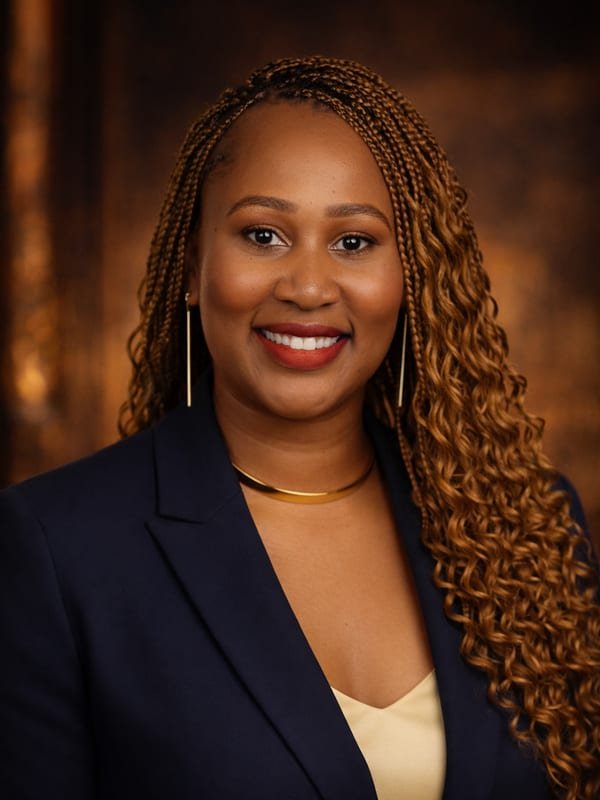 Esther Jackson-Stowell
28:57
Esther Jackson-Stowell
28:57
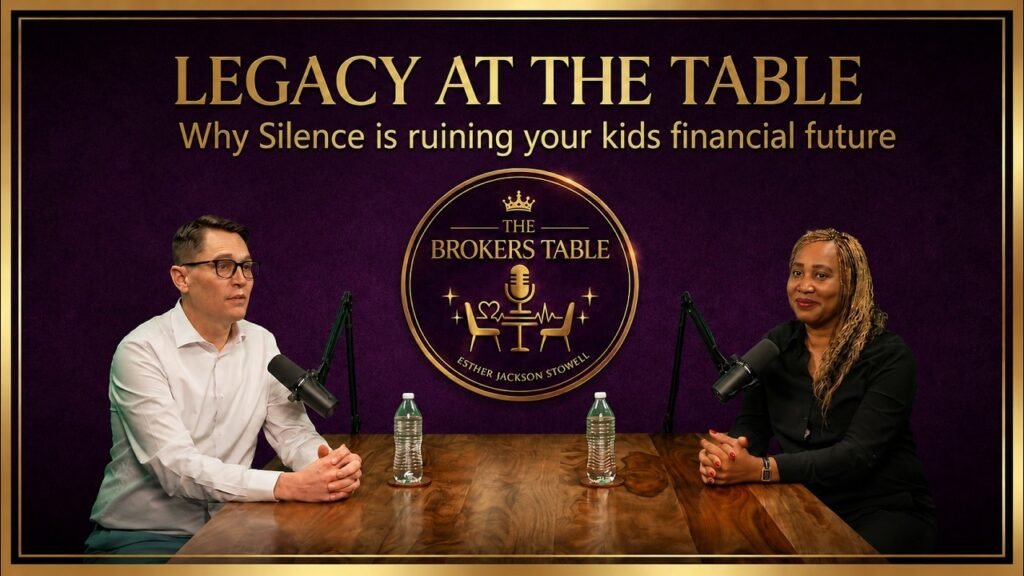 28:57
28:57
Open the audio directlyUse the player to pause, seek, or change playback speed.
From listening to doing
Find the words to begin.
Start a money conversation your children can take part in.
Free guideGenerational Wealth Starter Guide↗ Go furtherFamily Money Scripts$9.00 · Preview the pages ↗
Most parents believe they are protecting their children by keeping money quiet. Esther makes the case that the silence is the very thing setting them up to struggle. This is a clear, unflinching look at how financial silence gets passed down, and how to break it without passing down the fear too.
At the table
Esther unpacks the quiet inheritance almost no one talks about: the money silence handed from one generation to the next. She names the fears that keep families quiet, and offers a warmer, more honest way to raise children who understand money instead of just worrying about it.
What this conversation covers
- Why good intentions to protect kids from money stress often backfire
- The three conversation killers, starting with shame
- How children fill a silence with assumptions worse than the truth
- Turning everyday moments into real financial lessons
- Giving your kids context instead of anxiety
A line worth keeping
Our parents thought they were protecting us by not talking about money. But good intentions do not equal good outcomes.
Mentioned in this episode
- Legacy at the Table, Episode One, where the season begins
- The Broker’s Table community, for women building faith, family, and lasting wealth
The Broker’s Table is hosted by Esther Jackson-Stowell. New conversations on faith, family, and the kind of wealth that outlives you.
Episode transcript
Esther So when I was in my early 20s, I had agreed to buy a car from a friend's dad and I was so excited. And then something changed in my circumstances. I realized I wasn't going to be able to afford this car, but I was so afraid to tell him that I couldn't buy it. I had a conversation with my brother and I ended up getting motivated to just admit that this was not a good idea. I couldn't afford the car. It wasn't going to fit into my financial plan. And in that moment, I realized no one ever taught me how to have the difficult conversations around money. My family's version of financial education was, don't worry about it, dad will handle it. Which sounds protective, but you know what, it actually taught me that money was scary, that I couldn't be trusted with the truth, that I shouldn't ask questions. The silence was supposed to protect us. Instead, it left us unprepared.
Esther Welcome back to the Broker's Table, Legacy at the Table. If you're joining us for the first time, welcome to the family. And if you were here last week, thank you for coming back. Last episode, we shared our money stories and introduced what this season is all about. If you haven't listened to that one, I'd encourage you to go back. Today builds on that foundation. Today we're talking about the conversations most families never have. The money talks that should happen at the dinner table, but don't. And why that silence costs us generationally. We're going to get specific, not just talk to your kids about money. We're going to give you actual scripts, word for word examples of how to start these important conversations. By the end of this episode, you'll have a framework for family money meetings and the confidence to have conversations that might feel uncomfortable, but are absolutely necessary.
Esther Let's be real about something. Our parents thought they were protecting us by not talking about money. And I believe their intentions were good. But good intentions don't equal good outcomes. My parents never said money is scary. But when the only time I heard about finances was through the wall at midnight, that's the lesson I absorbed. Children are smart. They sense when something is being hidden and their imagination fills the gaps, usually with worse assumptions than the truth. I wish someone had taught me or told me how much money we make in the family, not because I wanted to know the numbers or needed to know the numbers, but it would have been helpful to have that framework. I wish my stepmom had explained how she stretched the budget. I watched her perform magic, making ends meet, but she never taught me the mechanics. It wasn't until I was an adult that I realized those were skills, not just survival. I wish somebody had taught me how credit works and how to build it at a young age. I wish someone had told me that investing wasn't just for rich people or people named Rich, but mostly just rich people.
Esther For us, the turning point was watching our kids start to ask questions. Are we rich? Why can't we buy that? How much money do you make? And of course, we can only do what we know. And often what we know is what we grow up with. And so if we wanted to make a change, we were going to have to not only decide to make a change, but also learn how to make the change, build those skills. We realized if we don't answer these questions, who will? YouTube? Their friends? TikTok?
Esther There are usually three conversation killers, one of them being fear of shame. The first thing that stops families from talking about money is shame. I don't want my kids to know we're struggling, or I'm embarrassed that we're not further along. But here's the truth: your kids already sense the stress. The difference is whether they have context or just anxiety. So what we've noticed with our kids is they don't have shame. They learn that from us, right? So whatever we're willing to talk about, they're willing to talk about, and they're willing to learn, and they often bring more knowledge and interesting perspectives to those conversations. And sometimes there are conversations like too much information.
Esther There's a second conversation killer, and it's the fear of judgment. We don't want people to know if we're struggling, but they also don't want us to judge. We don't want them to judge our bad decisions, right? So if we give them too much information or have those difficult conversations, we're afraid that there will be some judgment that comes with that. This is where age-appropriate transparency comes in. You don't have to share the exact numbers with a seven-year-old, but you can share concepts, principles, and the why behind decisions.
Esther The third conversation killer is fear of inadequacy. I don't know enough about money to teach my kids. Rich and I both felt this. But here's what we've learned: you don't have to be an expert. You just have to be willing to learn together. Some of our best family conversations have been, I don't know the answer to that. Let's look it up together. Or even, what do you think? That's your instinct. That model is something powerful. Learning never stops.
Esther Now we're going to go over to three rules of money conversations. Rule one, no shame. The first rule in our house, no shame. We don't shame each other for past mistakes, current situations, or questions that seem basic. So not too long ago, our middle son wanted to go on a school trip. It was an activity trip. Totally legitimate. Great, right? Well, he goes to a private school. We do not pay private school tuition. He's on scholarship. So he sees himself with these kids whose families might have a lot more expendable income. So these trips, they are not cheap, and we don't have that much expendable income at that moment. It's not disposable. So what did we do? He might have felt that shame in the moment thinking, oh, we don't make enough money to go. You and I, do you remember what we did? Yeah.
Esther What did we do? We sat him down. We let him know that it obviously cost money and how much it cost. And then we asked him what he could bring to the table. We made him a part of the conversation, first and foremost. We didn't just say no. We made him part of the conversation and we came up with ways for him to make it work, which would teach him that money didn't grow from trees. And secondly, that he could be a part of something that he truly wanted. And that was creating jobs for him to pay that back.
Esther He had to be part of the problem solving piece of that. He had something he wanted to accomplish, and we didn't have the funds right away to make it happen, but he was able to cobble it together partly through some of our resources, but then he had to go get his own work and income. And he was able to do that. I think if we had been ashamed of where we were at, number one, we might have just paid it. Like, we don't want our kids to think that we're too poor for them to have fun in school. And we probably could have made it work, right? But it wasn't in our budget. If we were ashamed, we might have made a different decision. But because we have this rule, we had an open conversation with him. He was able to go. It did not put a huge dent in our finances. And he was able to learn some really valuable lessons about planning and work and budgeting.
Esther And because this is something that he wants to do again next year, he now has a frame of thought in terms of how much it may cost, and so he can plan ahead. So instead of just hanging out in the summer, he can actually do some jobs that will save towards this big goal that he wants to meet. So again, we took an opportunity that could have been filled with shame and disappointment and made it something workable and something that he can now be a huge part of and something that he can use in the future. Because he will run into issues like that when he grows up, where he wants to do something or he wants to do something with his friends. This won't be the last trip, right? It will not be the last trip, the boys' trips and things like that. But it'll give him a chance to say, okay, my friends and I have this trip coming up in November. It's January. I need to have this much money by that time. What can I do in the meantime to save towards that?
Esther Rule number two: no secrecy. Age appropriate transparency is our standard. So our kids are part of the financial team, not outsiders to be protected. I mean, think about our son again who wanted to go on the trip. We couldn't have had a really healthy educational conversation if we were guarded with all of our information. This doesn't mean dumping adult stress on children. It means letting them understand that there is a plan, there is a process, and they're a part of it.
Esther Rule number three: questions are welcome. Any question, even uncomfortable ones. We'd rather explain than assume. So we tell our kids the only bad question is the one you're afraid to ask, because unasked questions become misconceptions that can shape behavior. This step or this rule is particularly important to me because growing up in a Nigerian household, you never asked why at all. You didn't even ask questions. You just did what you were told and hoped that no one felt differently or that you would get in trouble. Now being a parent and being able to allow our kids to ask us why is very, very new.
Esther It's something that I've had to get used to over the years because it wasn't something that I grew up with. But I have found it to be far more impactful in a very positive way that we're having these why questions, because it also helps me learn so that I'm not making assumptions. So it's been a very interesting shift, and it only goes to show the impact of asking questions and the impact that it will have in your life as well as your children.
Esther I think about the conversations we've had with our daughter who we adopted when she was almost 18, and she was learning to drive and buying a car and figuring out how to pay for insurance and all that stuff. There was a time when she was not licensed, almost licensed, and she wanted to borrow the car and we said no. Well, she thinks we're being mean, right? But she asks why, and we're able to have lots of conversation, not just with her but with all of our kids, about risk, about how insurance works and how that kind of stuff, if you don't understand, it can really impact your finances in a major way and in a lifelong way. So I love that she asked why. Sometimes we think, oh, the kids are just being snotty by asking why, they're looking for holes to poke in your argument. Well, great. Maybe you don't have a great argument. We had a pretty good argument because she was not licensed and insurance can be very expensive, especially if you get in a wreck as an uninsured, unlicensed driver. So I thought it was a great conversation. I was glad that she asked why. She probably wasn't as glad that she asked why because she got some knowledge that wasn't very convenient for her in that moment, but she can build on that knowledge. I think it sets those foundation blocks that we talked about earlier. But more importantly, she now has that knowledge that she can then pass to her children. So this is part of what we're doing here is building generational wealth. Like we talked about, wealth isn't just about money. It's also about the knowledge that you pass down. And that in particular was a very, very good example because I can see her sharing that with her friends. I can see her applying that to her life with her family. I'm grateful for moments like that. And we wouldn't have that moment if we didn't have her asking why or allowing them to know that they're free to ask questions.
Esther Okay, let's talk about some specific conversations you can have with young children, say like ages three to six. A big bugaboo topic for some parents: allowance. How do you pay your kids allowance and how young are they when you pay kids allowance? I would say when you start young, the smallest amount that you give them could be huge. So starting young to teach them — maybe it's 10 cents per day or something a little bit more than that, but having them do their chores, brush their teeth. When they're very young, that could be a great place to start. So they earn a certain amount or points from those little basic things. The only way that young kids are going to understand how money works is by having it and using it. So we have to start those conversations young with children. And you also have to give them money young. We believe that in its work for us and our family. Kids as young as three and four, they've earned their money and we allow them to spend it. And the interesting thing is when little kids spend money, oh my gosh, they spend it on the dumbest stuff, but they have to. That's the only way they are going to learn. It's valued to them, right? It's their value. It's their value is what they want to use that money for, but they make that direct connection between their labor and the thing that they exchange the money for.
Esther So I think just having those conversations really early on about how much their labor is worth in relation to what they want to go buy with it. And I was also thinking about how kids know what money is. They may not truly understand the concept of it, but they know that when you go into a store with them, that you are exchanging money for goods. And sometimes the kids will have you look for a toy when they're at the store with you. And that's a perfect place for you to say, hey, this is how much this costs. I only brought enough for groceries. We cannot get this right now, but we can come back after you've saved enough to buy this toy. And you can show them how much the toy is so that now they can know how much they can save and when they can come back and get that toy. And half the time they'll forget about the toy anyway. But the fact that you're having that conversation with them is helping them know that in order to get this thing, I have to give up something.
Esther Another fun thing to engage in conversation about with your young kids is just the price of things. So if you do shop, and sometimes it's a pain to take those little kids to the grocery store, but if you involve them even in the shopping experience, it can make it so much more rewarding for you as an adult and it can give them some valuable opportunities to learn. So you can ask them, how much do you think this should cost? Do you think this item should cost more than this item and have them start to make those valuations on things and recognize that there is a cost to things. And in a world of finite resources and finite money, you've got to make decisions between this kind of cereal and that kind of cereal or this toy and that food. It can be a game. And we know that these conversations and these experiences, they are effort. They take effort from parents, but that's our job, right? We're building that legacy, that generational legacy that we have to put that effort in now and it's really rewarding when you start to see it build after that first building block with the really young kids and we're going to get into that next.
Esther It's so interesting that you said that because as you were talking, that's all I kept thinking about. Oh, it's so much work to do that fun game that's not fun because you just want to go into the grocery store, get what you need and get out, but you have your little ones with you. So it is completely worth it to put in the time and effort now because once they have it down pat, then they can share with others and share with their children and it'll become part of their lives. With young children, it's about basic concepts. Young kids need to understand where money comes from, what its value is and how to get it. Those are the kinds of conversations that we've had with our young children and we haven't been perfect, but we think that they have worked pretty well.
Esther So an example of a conversation you can have with a four year old is, do you know how dad gets his paycheck? Do you know what a paycheck is? Just as simple as that. Do you know what mom does with the money that she earns, like that it goes into a bank and that from those funds we can pay for things like the house, the car, the water, the treats, the fun. And one of the things I love about that was, you know, when I was much younger, being told those things were more of threats. Like, don't turn on the light, you're wasting the electricity, or don't use so much water. Do you know that costs money? These shouldn't be threats. These should be conversations to help them understand that there is a cause and effect.
Esther You pay for this thing and then you get to have these things. Because a lot of kids, especially in America, do not understand the concept of not having electricity in your home 24/7. Not having electricity is just a scary thing. We took our kids to Nigeria one time and the power went out and our kids freaked out because they never experienced that. So there are other kids in other parts of the world that don't experience a consistency. So in teaching our kids, allowing them to know that this utility is on because it's paid for, and if we don't pay for it, we wouldn't have it. It's just bringing them into that conversation to help them identify where things come from. It's a building block. It's a building block that money comes from somewhere, that money is used to make our lives better.
Esther What you brought up is how to frame that conversation with a positive mindset instead of a scarcity mindset, like an abundance mindset, I should say. So instead of saying, you know, you can't waste this or waste that, which is good. We want them to not waste and we want them to conserve. But the shift is that because we can earn money from our labor and we can put it to work to get the things that we want out of life, we can pull certain levers and do more work or better work or have that money work for us in a different way. That's later down the road. That comes after the foundational building blocks that we're talking about of just these basic concepts. So you can definitely have a conversation with your three to six year old about the basic concepts of money and what it does for us.
Esther After kids have building blocks of financial literacy and wealth management, we can move into building skills. This comes at like age seven to 12. The only way to build skills is to practice. And so we've given our children money and they practice with that. Some parents might use preloaded debit cards as ways to give their kids opportunities to spend and to look at their finances. There's also apps that allow them to exchange money, store money, track their budget. I think those are great opportunities to allow kids at that age to build skills.
Esther Great opportunity, but also this is the time that we're living in. Before you could have your envelopes or your piggy banks, but now these preloaded cards are the way that the kids are managing their money these days. What I also like about that is that it gives me a little bit of leeway to see what they're doing with it. We can still teach them without necessarily holding them back completely, giving them the skills, but also giving them the freedom to sometimes spend all their money. And that's it for the week. That zero balance staring you right in the face. We use an app that allows us to see what their balance is, and it allows us to give them money. The one thing I like about that is sometimes I'll make a deal with them or I'll want them to do something for me, and they might be thinking, what's in it for me? Maybe five bucks is in it for you. Maybe it's 10 bucks for the little ones. Maybe it's two dollars. That's a lot of money for an eight year old sometimes. Those apps allow me to quickly reward them for good behavior and give them just more opportunities to practice. Absolutely. And also for the work that they put in. What was the age group we're talking about right now?
Esther Seven to 12. This is when they can actually do decent chores around the house. So taking out the garbage could cost a little bit more than 10 cents. One of the things that I've loved that you've done over the years was you've always made sure that the value matched what they were putting in. And that was something that I had a hard time equating. But somehow, I don't know if it's your love for math, but you've found a way to make it work for them and also make it exciting. Because I think what I would do is I would compare. I wouldn't take out the garbage for that amount. You'd have to pay me a whole lot more. But then what I've had to learn from you is that I'm not them. And what's less to me is not less for them. And so that's also helped me understand that. And then my job, I feel, is just to enforce it, to make sure that they're doing it consistently. Because I know at the end of the day, at the end of the week, they're going to want to get paid.
Esther And one thing that we've also done is that we allow them to let us know. We give them the benefit of the doubt to let us know if the job that they did that week was up to par. We don't measure it. We allow them to measure it, which has also given them a sense of autonomy and a sense of independence. But most of all, helping them recognize what value is.
Esther One of the things that we taught them early on, and by we I mean you, thank you, was to teach them about tithing. That's something that's important to us. So helping them understand that when you earn a certain amount of money, 10% goes to tithing. So now all of a sudden they're learning what 10% is. And they know if they go out and earn a certain amount of money that they have to set aside 10%. And I think that's something that's wonderful because it's also going to help them know that in the future, when they're now making money independently, there are taxes. So that they're not caught off guard, like, why am I spending 40% or why is 40% of my earnings taken? But so it's teaching them that there's taxes, there are tithing, there are things that money gets taken away for, and then you still have to budget the little that you have left. Well, hopefully they have a lot left. I mean, 10% seems like a small price to pay for all the blessings we get.
Esther We are a family of faith and tithing, paying tithing is an active faith. And you know, for younger kids especially, and as they're coming into adolescence at that age group of seven to 12, they don't want to part with their money easily. So you really have to build that skill. It does take work. I mean, our kids are not just going to pay up blindly. We have to teach them, we have to show them by example and encourage them. It is really a skill that they have to build. But I'm glad that you mentioned that because it really is a skill that will carry over into adulthood. Even if, I hope they stay faithful their entire lives and continue to be tithe payers, we see that as giving back to God, giving to charity, helping other people. We see a lot of value coming from those donations that we make. Even if they stopped doing that as adults, having the discipline to pay that off of every paycheck will build in some financial discipline that will certainly carry into adulthood.
Esther Absolutely. Let's talk about the family money meeting. One time conversations don't create culture.
Esther Regular meetings do. We recommend monthly family money meetings, 30 to 45 minutes. This isn't about creating stress or formality. It's about making money conversations normal and routine. Again, it's a skill, just another thing we do as a family, and we're going to be good at it. Here's our format, five parts, about 30 to 45 minutes total.
Esther First, opening. We read our family health mission statement together. This takes two minutes and reminds everyone what we're building toward. Second, wins. Everyone, including the little kids, shares one money win from the past month. I saved half my allowance. I found a cheaper option for what I wanted. We celebrate these. Third, check in. How are we doing on our family goals? Are we on track? What do we need to adjust?
Esther Fourth, learning. We discuss one financial concept or upcoming decision. Maybe it's what is interest, or should we take this family trip or save that money? One thing I really love is having those conversations. They don't happen that often, but we've created these investment accounts for our kids, and every now and again, we'll bring them in on decisions about what stock to buy. Joseph is part owner in McDonald's. He helped make that decision, because part consumer, his balance sheet is definitely in the negative, but at least it's good to know that you're paying yourself a little bit when you go to McDonald's for him.
Esther Fifth, closing. Everyone commits to one action before the next meeting, and we end with our family prayer, or most of you might call it affirmation. Now, will your kids be excited about family money meetings? Probably not at first. Ours weren't, but you can pay them to come. There you go. Start small. 15 minutes. Make it enjoyable. Snacks help. And be consistent. The resistance fades when they see this is just what we do now.
Esther Time to take action. First, take the conversation audit in Chapter Two of the workbook. Be honest about how often you currently discuss money with your family and what topics you avoid. Awareness is the first step. You can't change what you don't acknowledge. Second, write out three rules: no shame, no secrecy, questions welcome, and post them where your family gathers. The kitchen, dining room, TV room, wherever. Before every money conversation, review the rules together. It sets the tone. Third, put a date on the calendar for your first family money meeting. Use the framework we gave you. It doesn't have to be perfect. It just has to happen. The first one might be awkward. That's okay. The tenth one won't be.
Esther Start anyway. I wasn't kidding about paying your kids to attend a meeting. Silence is in protection. Silence is permission for misconception, for fear, for cycles to continue. Your children are going to learn about money one way or the other. The question is, will they learn from you or from expensive mistakes? I know because I've had plenty. You have the power to break the pattern, one conversation at a time, one meeting at a time.
Esther Next week we're bringing in reinforcements. Number three features our sons. Real conversations about raising boys with financial confidence and responsibility. You'll hear directly from them. What's working, what they're learning, and yes, what they don't love about how we do things. It's going to be honest. It's going to be fun. And it's going to give you a template for your own family.
Esther Until then, break the silence. Start with conversation. We'll see you at the table. Legacy isn't accidental. It's built on purpose.