
The Broker's Table · Episode 1 · May 2, 2026
Mission First: Dr. Rich Stowell
Dr. Rich Stowell on mission-driven leadership, military discipline, and what it really means to build a legacy that outlasts you.
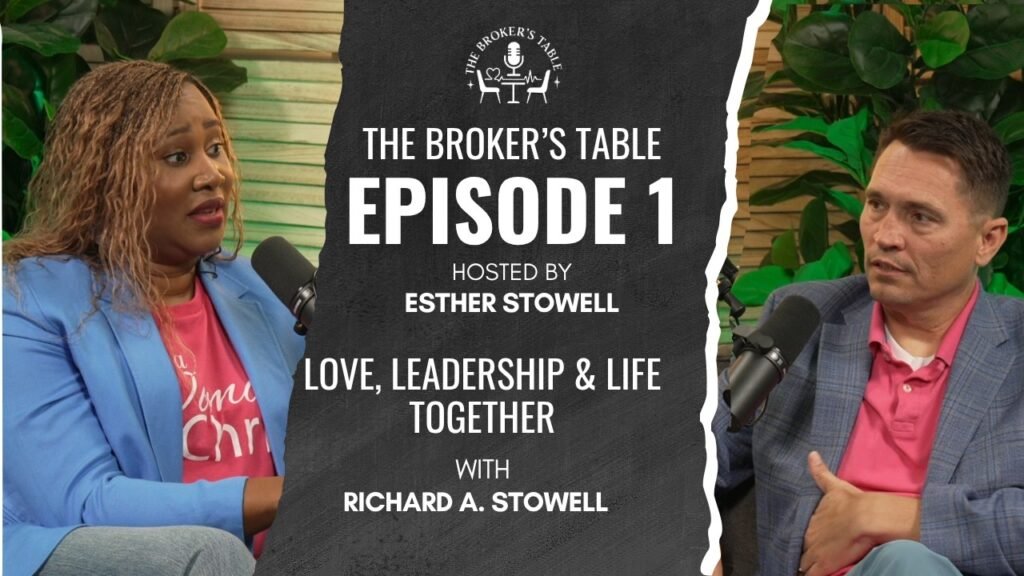
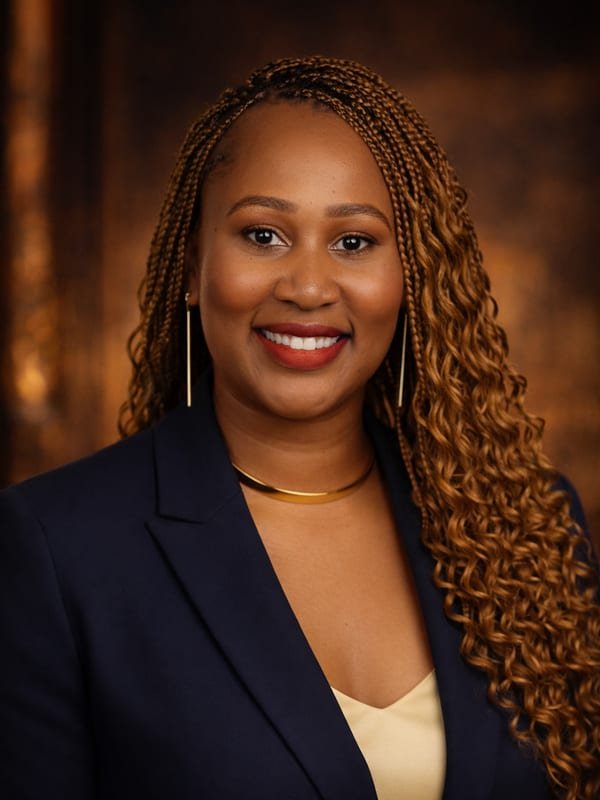 Esther Jackson-Stowell
with Dr. Rich Stowell
01:01:16
Esther Jackson-Stowell
with Dr. Rich Stowell
01:01:16
 01:01:16
Open the audio directlyUse the player to pause, seek, or change playback speed.
Key takeaways
- Leadership requires clarity before action - Mission First is not about being cold, it is about being clear
- Never Accept Defeat means separating the event from the verdict
- Never Quit does not mean Never Pivot - it means Never Disappear
- Never Leave a Fallen Comrade: refusing to confuse accountability with abandonment
- The Warrior Ethos translates from military service to family and business leadership
Before there was a podcast, there was a marriage that had to learn how to lead. Esther Jackson-Stowell sits down with her husband, Dr. Rich Stowell, for a foundational conversation on mission-driven leadership, military discipline, and the quiet work of building a family that outlasts the two of you.
At the table
Dr. Rich Stowell holds a PhD in Communications, served as a first sergeant in the Army, and directs communications for a Utah school district. Here he trades the podium for the kitchen table and talks about the Warrior Ethos, marriage across cultures, and what it means to raise children on purpose rather than by accident.
What this conversation covers
- The four lines of the Warrior Ethos, and how a soldier’s creed translates to a home
- Leading a family the way you lead people you are responsible for, not the way the world expects
- Building an interracial family without letting anyone else write your story
- Discipline as an act of love, not control
- The difference between reacting to life and running toward a mission
A line worth keeping
We are not really concerned with what the world is doing. It is what is best for us, our family, and the people who love us.
Mentioned in this episode
- The Warrior Ethos and the Soldier’s Creed
- The Broker’s Table community, for women building faith, family, and lasting wealth
The Broker’s Table is hosted by Esther Jackson-Stowell. New conversations on faith, family, and the kind of wealth that outlives you.
Episode transcript
Esther Welcome back to Berkeley's Table. Today, I've got a very special guest, my husband, Dr. Rich Stowell, which is a PhD in communications, a first sergeant in the Army, and the director of communications at Alpine School District. But at home, he's just a guy wrangling kids, making us laugh, and what else do you do?
Dr. Rich Stowell That sounds like first sergeant duties at home. I make our Sunday meals.
Esther Yes, he does, and I appreciate that. Today, we're talking about faith, family, interracial marriage, raising kids in the phone era, and what trust looks like, whether in an army, in schools, or in marriage. Rich, welcome to my table for once.
Dr. Rich Stowell Thank you for inviting me.
Esther Glad you're here. What do you want to talk about? So let's talk about a few things. The first question that I have for you is, what moment locked you into communications as your calling?
Dr. Rich Stowell What moment? I always saw myself as being a teacher. I mean, you know that when we met in school, I was preparing to become a teacher in California. That was fun, like teaching and coaching. That was a lot of fun. And then also, as you know, after a year or so, it was about two years of teaching, I felt this urge to join the military. I can't really explain where that came from, but I wasn't following a particular goal there. I just wanted to do that. And when that recruiter was visiting us, I was like, well, what can I do in the military? I didn't really know much about what the options were. And I remember he showed me a list, just a piece of paper, there's a list of all of the jobs you can do in the military. And the one of them that stood out as the most interesting was journalism. So that's what I was trying for in the military. And then of course, I did a couple of deployments and it just fascinated me. Every aspect of communication, the way they had us do it in the Army fascinated me. So they had us do strategic communication. They had us doing storytelling, embedded with different units, profiles, social media, some marketing, some stuff for recruiting. And it was just such a dynamic part of military life that was a lot of fun, continues to be fun. I mean, I'm still doing it, still loving it after all these years. So I think probably if I could pin it down to a moment, it might be one of my first classes at DINFOS.
Dr. Rich Stowell The Defense Information School, that was the school that I went to after basic training.
Esther I remember that. A lot of fun, a lot of really smart people going through that school, a lot of smart people teaching.
Dr. Rich Stowell I think, you know, maybe there wasn't one moment, but it's just like, there are moments, but accumulation.
Esther Yeah, they build on one another. But I think that might be where it started. I'd like to add to the fact that you said you looked at a list of things and then you just chose one. Now, that's really not how things work in a military. You have to take the ASVAB, and the ASVAB helps determine where you're going to be placed. Tell us about the ASVAB, Doctor.
Dr. Rich Stowell Well, I was not a doctor when I took the ASVAB. I did have a master's degree in teaching mathematics. I've only taken the ASVAB one time. I don't know if they change it up. I take tests seriously, and I somewhat enjoy taking tests.
Esther We catch that. He says he enjoys taking tests. I don't know anyone I've ever met in my life that enjoys taking tests.
Dr. Rich Stowell A lot of people, you talk to a lot of people sometimes and they say, oh, I know this stuff or I'm smarter than this, I'm just not good at test taking. I heard that from my students a lot. I am not that smart. I'm just pretty good at taking tests. I think the tests that I take, they sort of inflate my actual knowledge.
Esther I disagree, but go ahead.
Dr. Rich Stowell I took the test. I took it seriously and I scored very, very high. I think the fact that I was teaching math at the time that I took that test really, really helped me. I just breezed through that math section, and that's probably a big weighted section of the test. When I got finished taking the test, they score it instantly and there's always a sergeant moving you along or processing some paperwork or telling me what to do. There was a sergeant who was administering the test, and when he saw my score, he couldn't believe it. He's like, wait, what? He's like, well, that's pretty good. And he moved me on and he circled it and stuff. So when my recruiter saw that score, he's like, yeah, you can do anything you want in the Army.
Esther And I was like, sweet. Thank you. Okay, Dr. Rich does not like inflating his, you know, blowing his own horn. So I'm gonna blow your horn for you. He scored a 99 on the ASVAB, right?
Dr. Rich Stowell Yes. It's a percentile.
Esther And I feel like they just took off a point just because they didn't want you to have 100%.
Dr. Rich Stowell They didn't take off. The 99 is the highest score.
Esther Okay, but that was really impressive and you continue to do that every single time. I know you're a very humble person so you don't want to make it seem like it's a big deal, but it is a big deal for me because I'm one of those individuals that struggle with taking tests. So when I see someone who has that natural gift, it's so important for me to acknowledge it and let you know how cool you are because that is something that is not very easy for other people to do. So I will blow your horn right now and just kudos to you for your abilities.
Dr. Rich Stowell Thank you. I'm not good at conversation, really. With people, I'm not good at managing difficult or awkward situations with people. You're very good at that. I feel like growing up I was more introverted and I was kind of maybe in the shadows of my high achieving brothers a little bit. So naturally I didn't put myself out there and maybe I just made up for it on like, let me show them another way that I can get through life because I wasn't charismatic growing up. I was totally the shy one. I'd have nothing to add into conversations. I would try to avoid conversations. So yeah, I probably just spent my time scheming and trying to figure out how I could impress people without having to interact with them.
Esther You definitely picked a good skill that I've seen bless your life and bless our family because you're good at it. So thank you for that. Well, let's move on to the next question. Let's talk about our marriage. At what point did you realize that it was gonna be a stretch or it wasn't gonna be as easy as maybe what you thought?
Dr. Rich Stowell No. I've never thought that. There was one moment that sort of made me think in a different way, but it was never a stretch.
Esther When was it? When did the hall with all the chairs?
Dr. Rich Stowell Oh, that's a good story.
Dr. Rich Stowell I'll tell that momentarily. But it was 2004. I don't think we were engaged at the time, but we were getting serious and I talked to my dad, probably talked once a week or something. And in those conversations, like, are you dating somebody or anything like that? Those kinds of things would come up. And so I told him about you. And he's like, oh, that's great. I'm glad that things were going well with Esther. And of course he hadn't met you or even seen a picture of you at that time.
Dr. Rich Stowell But I volunteered. I said, well, she's black. And I don't remember his reaction. It didn't catch him off guard. He probably was just like, oh, you know, like, why are you telling me this? And then I followed it up with, is that going to matter? And he said, no. And we kind of moved on. And I don't know why I felt compelled to like just check. But yeah, I don't think the fact that we're from different racial backgrounds, I don't think that's ever been like a source of stress for me.
Dr. Rich Stowell Now there's been like those cultural things that are different, like independent of race, right? The cultural thing. And you mentioned all the tables in the hall or all the chairs. So when we were planning our wedding reception, we had a church up in Oakland and, you know, we tried to involve as many people as we could in the planning — some people from my family, some folks from your family took different parts of this reception planning. And we were checking in on it and we turned up at the reception hall one evening. I think it was probably the night before, yes. And this place was stuffed with — they must have brought in outside tables. This was a pretty big reception hall and all these round tables stuffed in there, like no room to even navigate between the tables once you got the chairs in there. And I was like, this is not conducive to the type of event we want to have where people have some freedom and they can move around and go mingle and talk. And yeah, we got in a fight with your uncle and that was just a reminder to me that there was one thing that still stands out from that episode. He was mad that I was challenging him. I was upset that he wasn't respecting our wishes.
Esther He seemed surprised that we even had wishes that we thought he should respect, right? Just thought this was totally up to him. And I said, Uncle, this is not your wedding. And he said, yes it is. And I realized in that moment we just came from different perspectives, and that's helped.
Dr. Rich Stowell No fights since then, right? With any of your...
Esther That's because we don't talk to people. I'm scared.
Esther On that day, I think what stood out was the fact that I got to learn how the typical LDS weddings and African weddings go. You know, with—or I should say Nigerian weddings—we don't limit who can come by sending out specific invitations and people just show up. And so you just plan for a ton of...
Dr. Rich Stowell Plan for a thousand.
Esther Right, minimum. And then the typical LDS, you know, like the typical Mormon or LDS cultural weddings, it's people come in, they line up, they greet people, and then they kind of walk out and leave. They'll sit around for a little while and then they'll leave. And my little while, like very, very little while, whereas the Nigerian weddings, like people actually come to party. Like they're gonna be dancing through the early hours of the morning, they're gonna be eating the whole time and just hanging out. And that's the cultural clash that we were seeing where in my uncle's mind, he was setting up for people to come in and sit down and actually enjoy for a long while.
Dr. Rich Stowell I think we've navigated that pretty well. There's been times, I think, that my family hasn't been thrilled with some of our decisions. And I know your family probably hasn't been thrilled with some of our decisions. But it's been our decisions. It's like it works for us, they can live with that.
Esther Yeah, we will.
Esther Okay, so we're still on the topic of interracial marriage. I will say that when you and I met, I mean, I obviously saw that you were white, but I saw beyond that. I saw the confidence of the man who walked up to me and said, hi, I'm Rich. And I just, I know in that moment, I thought, well, like, wow, he's really confident. Like he just walked up to me and just spoke, and I had never really experienced that in that manner where someone was very direct with their intentions. And I think that's why I was confused for a while when you kept inviting me to events. And I just kept thinking, maybe, maybe I'm reading this wrong. Maybe you just want to fill seats. And I'm just thinking, oh my goodness,
Esther This incredibly handsome man is interested in me. And it wasn't until, again, with you being very direct in your intentions, which I completely appreciated, we had a conversation and it was very beautiful. I still remember that till today. But for a long while, I honestly did not really see us as being an interracial marriage because your personality is just one that's very open and free, and I don't see you bothered by things that most people are bothered by. And your reaction always catches me off guard because where I expect you to be mad, you're not mad, you're more reasonable. Where I expect you to be, I don't know, you're just very different. And I think that's probably why I never saw you as like Rich, just a white guy. You were just Rich with this great personality, confident man.
Esther And it wasn't until, I think you were arguing with a cousin online one time, and they pointed out that, hey, you should know better because you're in an interracial marriage. And I was like, he is? And it wasn't until that moment that it occurred to me that we were in an interracial marriage, even though I had seen that all the time, right? You see it in the movies, you see it in person, but I never once saw us as that. So that moment really caught me off guard too. So what has been your take in what everyone else sees in terms of when they look at us as being an interracial marriage? How do you see our relationship in our marriage?
Dr. Rich Stowell I don't know, but there's been some episodes where they got me thinking about that a little bit more. Do you remember when we were in New York on the Staten Island Ferry coming back and this African American man started hitting on you and I wasn't sitting right next to you? So it looked like you were all by yourself and this guy starts hitting on you and I'm like, I didn't feel insecure. I mean, this guy was, he couldn't compete with me. So I just kind of watched and I was like, how's Esther gonna handle this? And that was pretty funny. And he finally got to the point where it was obvious that he was hitting on you. I don't know if he asked for your number or if he asked if you were single or had a boyfriend or something. And then you pointed over to me a few seats over and said, yeah, I'm here with my husband. And he looks at me in utter shock. But then he was like, he might've given me a fist bump or a high five and he's like, good job. And I'm like, I know.
Dr. Rich Stowell That's mostly how I feel. Like if we ever get looks or if there's a sense that people think we're odd, and that doesn't happen often, I think it's going away. I think sometimes if you're looking for something, you will find it. But I think you and I have always had this personality where it's just you and me. We're not really concerned with what the world is doing. It's just what is best for us and our family and the people that love us.
Esther Yeah. And I look at it as opportunities. Like if we ever surprise somebody, right? We come in as a couple and it's a surprise that we're in a ratio. I look at it, or I have looked at it in the past, as an opportunity to show them what a healthy marriage could look like. And so then hopefully they quickly see beyond the race and they just see a relationship there.
Dr. Rich Stowell Good answer. So talk about, tell me about your dissertation. Your dissertation was on the Warrior Ethos. And I remember that because I had to do a lot of editing.
Esther You did. So much so. You had to do a lot of prodding. So much so that I am now unable to read a text. We didn't email without finding errors. So thank you very much.
Dr. Rich Stowell But on that same note, how do you think the Warrior Ethos applies to schools, raising children and relationships?
Esther To me, the Warrior Ethos has become...
Dr. Rich Stowell Let's put an opinion on that. Explain to us what the Warrior Ethos is.
Esther Okay, so it's a credo of US Army soldiers. When I went through basic training, everything was geared around trying to teach army values. And one of the ways that they instill those values in new soldiers is they have us memorize and reflect on the soldiers' creed. Part of the soldiers' creed are these four statements that comprise the Warrior Ethos: I will always place the mission first, I will never accept defeat, I will never quit, I will never leave a fallen comrade. Those statements help people navigate tough times. And in the army, there's bound to be challenges. So those statements help soldiers make sense of what's going on around them and help them take action to do the right thing. Most of us aren't in combat, but we have these daily challenges. And so over the years, I've thought it was interesting if you live something like an Ethos, like a Warrior Ethos.
Dr. Rich Stowell You're going to have this almost like this reservoir or this ready reaction for almost any challenge, right? Mission first. That's a pretty simple thing. I've got something to do, I'm going to get it done. And then I can complain, or then I can rest, or then I can move on, right? Mission first. Whatever the mission is for you in a given moment, everybody has a mission. I think one of the things I've taught some of the young people I've worked with is if you don't know what your mission is, then that's your mission. You gotta figure that out. Step one, right? Don't quit. Don't accept defeat. Don't leave people behind. Bring people along with you.
Dr. Rich Stowell So I wanted to study that. It was kind of fascinating to me because of how organizationally the Army decided on the Warrior Ethos came at a particular time in our country's history and in the culture that I think was a good fit. But I wanted to learn more about how that came about. So that's what I studied for my dissertation. And it's communication because organizations all over the world, big and small, most of them have some sort of a mission statement. And those mission statements are designed to help members of the organization get through challenges, right? I feel like in this case, the Army set the gold standard.
Esther And in that same tone, how do you feel that that applies to your job in communications in schools?
Dr. Rich Stowell Again, mission first, that's the first part of the Warrior Ethos. A true warrior is going to—and let's just back up a little bit. There's a difference, a distinction drawn between warriors and soldiers, right? Soldiers serve the state, soldiers are professional, soldiers are paid, soldiers learn procedures. And that's all good, there's a time and a place for that. But the reason the Army at the time wanted to instill an ethos around the warrior is because warriors are driven by something more than or deeper than the state. They're motivated by a set of values that transcend any government, any political allegiance. So it's kind of a value-driven proposition with the warrior and warriors. I mean, we think of warriors, and more often than not in our culture, warriors are venerated. I still think back to the musical,
Dr. Rich Stowell The Greatest Showman, and you know the story, that these outcasts are brought together by this fellow who's trying to set up his circus and he gives voice to these people who are sort of downtrodden or shunned. And there's this great song, I think, and it's, "This Is Me," and it's kind of like a protest on these outcasts. They sing this beautiful song about how they're not going to hide anymore. And one of the lines in that is, we're warriors, that's what we've become. We're warriors. Don't mind my singing voice.
Dr. Rich Stowell I think people look at warriors and they respect them and they don't see soldiers. Warriors are people who can overcome adversity. They're fighting battles and they keep going and they conquer. Whatever they need to conquer, it could be personal challenges, it could be forces against them, challenges, it could be family struggles. Warriors persist and they fight and they overcome.
Dr. Rich Stowell In schools, we need more of a warrior mindset in schools. So being a warrior in a school, whether you're a student, teacher, administrator, you're putting your mission first and you're not quitting and you're not leaving behind a fallen comrade. Like if somebody's fallen behind you, you pick them up and you bring them with you and everybody finishes the race. The other thing that I've learned from the army and the warrior ethos helps to reiterate this is, we do have a mission. Whatever our calling is, whatever we're doing in life, mom, dad, kid, student, teacher, whatever your job is, you have a mission, figure out what it is, be able to articulate that and then do those things that can help you accomplish the mission.
Dr. Rich Stowell I think people fail and they struggle in life when they lose sight of their mission and they let life push them around. Warriors don't do that. Warriors are living in the same chaotic, sometimes crappy environment that the rest of us are living in. A warrior will look at that and say, okay, where are my obstacles? Let me design a plan to avoid the obstacles, leverage the advantages that I have so that I can accomplish a mission. So it's you taking control of the situation and getting stuff done.
Esther As you say all of this, it makes me think of our family and how we operate, and I see a lot of the things that you're saying apply to everything that we do. For instance, you and just us communicating. I know that the way that I communicate with you has changed over time, and I remember from the beginning, communication has always been one of your strongest suits, and I know that because of that, it has made me communicate better. You're by the way, you're way better at it than I am. I'm just more outspoken, right? You're way better, and whenever we have problems, I'm like, let Esther handle that because I cannot get it together.
Esther I would say that you have helped me argue so much more efficiently and better, to the point that you and I don't even argue anymore, because I came into our relationship in a way that I was shut down. I didn't want to discuss it, and you're like, no, we're going to talk about this. I hated it. Absolutely hated it. But over time, you being consistent with that — okay, we are in a relationship, we want this relationship to work, so we're going to find time to talk — it definitely forced me to get over the things I didn't like having to address. And because of that, it made me a better communicator. You may have gotten the PhD, but I definitely know that I was learning along with you, and I absolutely appreciate that. That dissertation is half yours, right? I should just start putting my name: Dr. Esther Jackson Stowell.
Dr. Rich Stowell Well, I'll mention this other story that you probably remember, but for anybody listening, there was a moment towards the end of my doctoral program that I wanted to quit. Do you remember that? I totally wanted to quit. It was too hard and I was like, is it really worth it? And you just said, nope, you are not quitting. You wouldn't allow me, so I appreciated that. I think if I was on my own, I probably would have quit.
Esther Do you remember what I told you? Shall I share? At that point, we had spent seven years in this program. Before we moved out here, we had made the decision for me to start my business while you pursued your PhD. And I had started my business and I was doing my part. And so when you said you wanted to quit, I was like, absolutely not. If you quit, then we're moving back to California, because we're not moving back to California. At that point, it wasn't so much about you anymore. It was about our children. I did not want to leave a legacy of quitting hard things.
Dr. Rich Stowell That was good. I think that's a lesson that stuck with me. It's powerful for us to have those hard experiences so we can go back to our kids and be like, you don't quit. We don't quit in our family. We keep going. We figure out ways to make it work. It doesn't mean you can't adjust. We've put a lot of adjustments, but don't quit.
Esther And more importantly, I remember telling you, I'll read all your papers.
Esther I will show up in class with you. I will do whatever it takes to help you cross that finish line. But you don't get to quit unless I get to have my seven years back. And here we are. And I remember thinking, for me, I really didn't care about that title that you were going to get. It was about you finishing. That's all I cared about because we are raising two beautiful boys and two very impressionable girls. And I want them to know. I don't want to just have to tell them what to do. I need them to see our actions and see what we're doing, because my mother's actions definitely impacted me and who I became, as well as my dad. A lot of the things that my dad has done in his life.
Dr. Rich Stowell What were your mother's actions that inspired you?
Esther Well, the biggest one was her relationship. And even though in everyone's eyes, she quit. But her reason for letting that go was so that she could be alive to see us today. And I feel like that's an example of adjusting, right? She knew her mission. I think at some point she probably decided that it wasn't her purpose in life to please your dad. She had to be true to herself. And that was her mission. And I don't think she quit the marriage. She refused to quit herself, because I think staying in that marriage would have been her giving up on herself.
Dr. Rich Stowell Absolutely. And she refused to give up.
Esther Absolutely. And that's the legacy that she left for me, the legacy for me to stand up for myself, to just know what's right and stand up for it.
Dr. Rich Stowell I love your mom. I met her one time, right?
Esther Two times. Because we went to her house the second time.
Dr. Rich Stowell Your mom's so cool.
Esther She was absolutely amazing. I tell people I didn't get the opportunity to grow up with her, but so much of who she was is in my DNA and so deep.
Dr. Rich Stowell You got her optimism. She's relentlessly optimistic. She had a big smile. I'm like, what are you smiling about?
Esther She was amazing. And she was just so humble and ready to help everyone. But she was not a pushover. And that was the beautiful thing about it. And I think that's what sometimes people confuse — how kind I am to be a pushover. But you'll learn really quickly that's not the case. Part of being in a marriage is being able to learn from one another.
Esther And I think you and I have absolutely enjoyed that dynamic. And one of those dynamics is my learning more about the warrior ethos and being able to apply it into my organization that I run.
Dr. Rich Stowell What was the first one of the warrior ethos?
Esther I will always place the mission first. So when I do real estate, right, and you know that I'm a realtor, I keep the clients first. And I'm not saying that clients are never wrong, but we keep them first and we want to make sure that what they need comes first versus our needs. And then the second one, never quit. I expect our employees to be that way. If there's an issue, I want them to go figure it out, go solve it. And if you can't solve it, get help. There are tools, there are people, and that is my expectation. Never quit. And that doesn't mean, like you said, doesn't mean that you shouldn't adjust, but you need to keep going and figure out a solution. And then the third, defeat. That means if you go out there and they tell you, oh, the door is shut, find the window.
Dr. Rich Stowell Yeah. The window shut, find a crack, okay? And if there are no visible cracks, air is still going into that building. Find out how that air is getting in there and figure it out and get in and get the answer or solutions that's needed.
Esther Yeah. And then the last one, don't leave anyone behind. Don't leave anyone behind. I absolutely feel, and Tyler Perry said this in one of his acceptance speeches, that he realized that what he was doing was more than him, that he was helping other people come up. So when he started his studio, that was what he was doing because he was now employing people. He went from running his own production company pretty much single-handedly to now having a whole production company where he's hiring people, not just actors and actresses, people to do just like landscaping. Now he's creating an avenue for other people to rise. And I see that as my legacy. So when we talk about never leave others behind, that's what I think about, where when I'm out here doing these things, it's not just about me. It's about the next generation, the next people that are going to be able to come up. And I am so grateful that in just this short period of time, I have had the opportunity to do that for someone, for quite a few people. And I look forward to doing more of that. It's been beautiful to take what you do in your occupation as a soldier and allow me to use some of that into what I'm doing as an employer. I know that we do it as well in our family with our kids. We have something where you also instituted this in the family where we had dress...
Esther Right, dress. And so our kids now know how to put their shoes on. They're still struggling with it. They don't do it consistently, but they do know how. And those are things that have been very, very instrumental in all that we do. So I'm glad that you've had that training outside of just being a dad and a husband in so many different areas of your life that has allowed me to apply to my business and allow us to apply to our family and for us to continue to grow.
Esther I appreciate that. In the past, this is one thing that we do and I thank you for it because I come with complaints and you're usually good with like, okay, how can we solve this? What can we do to help the kids see what it is we're trying to teach them? Maybe that's a teacher in you, but I love it. And one of them was the no phones rule that we implemented. How did that go?
Dr. Rich Stowell We learned something a while ago and I haven't thought about that in a long time. I mean, it wasn't like this grand momentous moment for our kids, but it was an interesting experiment that we ran. And I think about even now, I'm thinking how much phone time or how much dependency on a phone is too much for our kids. Now in Alpine School District, well, the state of Utah passed legislation fairly recently that basically banned cell phones in schools during instructional time. Our district has increased the restrictions on phones in most of our classrooms. So basically our high schoolers, they can have their phones at lunch and they can have them out during passing periods. Junior highs typically can have them out only during lunch, and elementary schools no phone. I think that's pretty prudent.
Esther I always think about, like, I worry that our kids are on their phones too much or in front of a screen too much. But what we learned when we tried to take it away, it was really hard. It was impossible. All of our routines, just the way that we operate — alarms — I feel like compared to other kids, our children do very, very well. I don't feel like they're addicted. I feel like they use their phones for good stuff as well as frivolous stuff. They have their guilty pleasures that they do. One of our sons dances a lot and he records a lot of dances. I'm good with that. He's dancing and he's doing what he loves and he's getting exercise. He posts a TikTok and then he's worried about the views and the likes and stuff, and that worries me because if that's what's motivating him, I feel like that can become a very vicious cycle. But so far, I don't think it's ruined him, but I think it very easily can ruin kids.
Dr. Rich Stowell Absolutely. We tried taking their phones away and we realized it was like trying to hold back a river. We relaxed a little bit, but I think number one, we learned the trade-offs aren't as easy as a lot of parents think — oh, I'll just take the phone away.
Esther I grew up without a phone, right? And I often think — I mean, we were talking about our marriage and when I was explaining how my dad hadn't seen a photo of you yet, that sounds strange now, right? Because we're always taking photos and sharing and texting. But this was back before we even had picture-taking phones. I mean, you and I each had a flip phone. All it did was call. I probably sent my first text a few years after we were married. So of course he wouldn't see a picture of you. There were no pictures to see. It's strange to go back to that.
Dr. Rich Stowell Now the digital connections are so ubiquitous, it's hard to take that out. It's like removing something — you'd have to rip it out of the body.
Guest It's like part of everything our kids do. And the trade-off there is, are they going to be left out? Are they going to be left behind by their peers? We don't want to do that to them. We don't want to make them the weird kids. It wasn't weird growing up to not have a cell phone if they had to go to school. Once everyone started having cell phones, if you didn't have a cell phone, it almost seemed odd. So now as parents, we're navigating that and it's just challenging. It's easy to criticize parents who go too far in one direction, but parenting is just hard. Every day you're making a thousand decisions, one of which could have some pretty big consequences for your kids. And the bottom line is you're never going to know which one will be the one that breaks the camel's back.
Guest But one of the things that I've learned with all of that was instead of trying to keep them off of the phones, we teach them how to manage the phones — what to watch on the phones, what not to watch on the phones, how to communicate on the phones, what not to communicate through the phones. I remember we talked about filming: make sure that things that have your location aren't visible on there, don't give people your addresses. I think we saw a video where some kid talking to some grown man on one of the things he was playing gave him the address, and the guy showed up at his house wanting to date his mom.
Esther Wow. We can have that.
Guest No, but those are the things that I think — the world is changing, and we cannot stop that growth. And instead of trying to stop it, I think what we need to focus on is how to help them navigate it in a way that it won't ruin them. I know that we mentioned our oldest son with his videos and his likes. And I talked to him about that and I asked him, do you — I mean, it feels good, right, to have those likes, but if you didn't have those likes, would you still survive? And he's like, yeah. And so it's about having those conversations instead of just seeing it and not having conversations with the kids. At least having those conversations allows them to know that. And now you're aware that they're aware, and if they have an issue, it could be discussed.
Esther I think lots of different things motivate different people, and the likes and the views in and of themselves aren't a bad thing. But I think what's scary for parents is that those algorithms and the way that those platforms are set up can very quickly — because everything's so fast, right? You post a video and instantly you're getting likes and stuff. I actually get impressed with Joseph. He's got some videos with lots of likes. And sometimes I'm a little scared, but it's so fast that that feedback loop is happening so quickly with the kids that it perpetuates or it encourages obsessive behavior. It's one thing to publish a book and then you see how many people buy it over the course of a few weeks. And yeah, you can get excited about the sales or disappointed by the sales. It takes time to see results. Or like you start to feel better and you don't really notice it, and then six months later, you might look in the mirror and you're like, oh wow, I'm a different person now. But because these things are happening two, three times a day, the feedback loop is so much tighter now that it drives every behavior, or for those who get obsessed, they can drive everything they do, right? They cannot think about other things other than how to get the next like or how to get to that next level.
Esther That's the scary part. So I do think one thing that we've learned is you can tell the kids, put the phones down, you know, we're going to have a day without phones or just a few hours without phones. Let's go outside and hang out in the yard or go for a walk or something. That's fine. Like you said, they'll survive. What are some things that we have implemented? And when I say we, it's really you. Again, I am so grateful for you for that because you come up with these things where you come up with substantial things for us to do.
Dr. Rich Stowell For about the last six months, we've been getting these status reports from our kids. So we always have these family meetings and I love those meetings for the most part. It's just a way to come together, remind kids that we're still there. They can't wander too far away without us bringing them back in, right, and check in with them. And they're just very practical meetings. Recently, we've implemented this reporting system that we call SF squared, SF. So S is school, the other S is sleep, one F is family and friends. So they need to report on those four things and all they have to do is good, right? So they'll say like school, okay, friends, good, family, good, sleep, not good. And then you and I can follow up later and correct that because sleep is super important. So I think that's been helpful. That was inspired because you and I went to a couples retreat like a relationship workshop, marriage workshop. It's also nice to be able to tell them that we're constantly working on stuff, right? We're trying to learn and improve again.
Esther More action, less talking. Yeah. Just show them what you're doing.
Dr. Rich Stowell I know when they give us their status report, they don't really say much, but what I love about it is the fact that they know that we're asking about these things. And because it's so structured, it'll be memorable because we do care. We do care about their sleep. We do care about their friends. We do care about school. And we do care about the family and how they're going along with one another.
Esther You've taught our kids to be honest.
Dr. Rich Stowell Yes. I did not grow up in an honest home. And if my parents heard this, they might be disappointed. We were not taught to lie. It wasn't like that, but it was like, I did not share feelings. It wasn't honesty. It wasn't that I grew up in a dishonest home. It was okay to not be fully candid all the time. And you've taught our kids to be candid about everything. I mean, the stuff that Joseph will talk to us about, it's like, I love it. I love that opportunity to connect with him and influence him. But I'm like, I would never have shared that with my dad growing up — different era. But I think that's a credit to you because you can have these conversations with all of our kids about hard things or uncomfortable things.
Esther Uncomfortable things. I have no problem with it. And they do, though. They get through it. I'm not as good. But I think that for me comes out of like a necessity, right? Because I didn't have that opportunity to even say anything just to speak freely. And you know, I tell them the story of when I came to the United States, I never once...
Esther You had the opportunity to just speak up and ask why or what's happening. Well, and you do that with your clients and with your business partners too. You just let them know exactly what you're thinking. But the thing that is impressive is there's never any hard feelings, right? You can deliver bad news with a smile. I can't do that.
Dr. Rich Stowell Well, thank you. I just don't have the patience. I don't have the patience to sugarcoat things.
Dr. Rich Stowell Yeah, it saves time. If we spend time beating around the bush — the most valuable thing we have on this earth is time, right? So I want to use my time very, very wisely. And so if we're sitting around and someone is spending three hours with something that could have been accomplished in like 30 seconds, I'm going to be upset because you just wasted three hours of my life. So get to the point. And I do get like that, you know, after a few seconds of giving me this flowery —
Esther Yeah. Like that's another thing he does very well. You spend so much time just painting this big old masterpiece when, you know, right in the corner here is what we should have all focused on. So it's something that annoys me, and so I don't like wasting other people's time. So get to the point.
Esther So let's talk briefly about how being married to you has definitely shaped my life as an entrepreneur, as a mother, and especially as a wife. Now, growing up as a Nigerian, there are certain things that are expected from a wife culturally. And those things I don't do in our relationship, and it's really hard sometimes for me. We were talking about that this morning. I walked into our kitchen and you were there making omelets for the whole family. And I told you, you know what, I feel really bad watching you in that kitchen making that.
Dr. Rich Stowell She let me make the omelette. She didn't feel that bad. She ate it.
Esther Absolutely. But then we talked about it and you said — what did you say? You said —
Dr. Rich Stowell I said, so you don't feel bad. I said, what are you going to do with that guilt? With that guilt?
Esther Nothing. Nothing. Absolutely nothing. But then that gave me a chance to kind of ponder why I was feeling bad. And even just to think about why — what am I really feeling? Is it that I'm feeling bad because I don't feel guilty? So what it came down to was shame. I was feeling shameful because I grew up with the notion that the wife cooks and prepares food for her husband. The husband comes back from work and there's this plate set up for him, and he just comes and eats, and we even bring him water to wash his hands. And then he just gets up and goes and sits down and watches TV and then goes to bed.
Dr. Rich Stowell Well, so do you feel like I've kicked that habit out of you because I don't like Nigerian food?
Esther Well, that's one reason. You don't like Nigerian food, so the preparation of the big feasts is not even there. Secondly, you don't eat a lot. You don't eat like the typical Nigerian man — they would have their mound of fufu. So that's two. And then half the time when I — I remember I used to call him and say, hey, you're gonna be home —
Esther And thinking, oh, you might want something to eat, and you're like, no, I already got McDonald's. Well, I think about this. It goes back to the mission first attitude. What is the goal of eating? When you're coming off from work, maybe this is like overthinking it, but the goal of eating most of the time is to get enough calories in for you to go another day. It doesn't have to be fancy, right? It's a practical thing. It's a necessity thing. And so there's no reason to overeat. Now, sometimes the point of eating is family, right? Getting together, having a conversation at the dinner table or celebrating. In those cases, yeah, I can keep up with people.
Dr. Rich Stowell This is what I'm talking about, eating how I want to eat to be healthy. I've recognized that I'm older and my body can't handle the same amount of calories and the same diet that our teenage boys can. I look back on those days fondly when I could put down a couple of double cheeseburgers, no problem, like our kids can do. I don't miss it though. I don't need that. That's not what I need at my stage in life now.
Esther You don't have to feel shame anymore. That's one of the reasons why it's been difficult. It used to be very hard initially for me to switch from that, because what I realized now that I was feeling was shame. Like, what if a Nigerian person walks into my house and saw you in the kitchen cooking? What would they think? I'm at the point in my life where I don't care what they think, so that's fine. But there's still part of me that thinks, oh, maybe I'm not taking care of you well the way that I'm supposed to. But then I also realize that I don't give you headaches like most people do.
Esther Another thing that's a little different is when I'm doing my hair, you're coming and you're like, you're still doing your hair? I'm like, yes. Yes. It's been 16 hours. But it's a cultural thing, right? It's just very different, but it doesn't stop me from doing my hair. Or another thing that you definitely do is you're very, very involved with the children. That is something that's different from how I grew up. Like the children were just there to entertain dad when he came home from work for like a little bit of time and then they would go to bed. But you are very involved with the kids, and it's beautiful to me. Sometimes I'm just in such awe of you.
Dr. Rich Stowell I feel like I'm not as involved as I should be.
Esther You have no idea. Maybe you have a different standard, but for me, I know that they can come to you for anything. That's number one. Like you said, there are some times that Joseph tells you things and you're like, ugh, I wish I didn't hear that, but it's okay. I'm just going to take it in. And that's a very huge thing for the child to be able to come to you and just say, hey, I'm having this problem with this girl, or what do you think? Like those are beautiful conversations that I see them having. And then Gabriel, like you running with him, you know, that's also something that's beautiful.
Esther I feel like every child in our household has this deep connection with you, even though they still call me for everything — mom. But I think that's just a very natural thing that happens in all families. I recently saw this video of these dads pretending to be their daughters. One of them says, "Dad, where's mom? Where's mom?" And then the daughter says, "I don't need you. I need mom. Like you can't answer my question. I need mom." And I think part of it is just moms — we know where everything is because we know someone is going to ask us for it. So we go around the house looking, scanning, like, okay, I need to mentally know that that sock is over there because so-and-so is going to ask me in a few hours, and it always happens anyway.
Esther Going back to just the things that you do versus culturally that you do that I didn't grow up with — the way that you are with me is also beautiful to me because I feel like you allow me to be myself and you give me the space to be me wholeheartedly. And I don't feel like there's anything that I want to accomplish in this life that you will ever have a problem with. And perhaps it's just that you trust me and you see my value and qualities. I don't give you questions to think that I'm going to do something dumb. But I enjoy that. I enjoy the space that you give me to do those things. And so we're sitting here at my podcast and running my company, but it's all ours, right?
Dr. Rich Stowell I mean, I feel like we give each other space. I think it would be too stressful if we were always keeping tabs on each other and up in each other's business. You're running your business and you're talking to people and I can't keep track of it all. It's a lot. I'm aware of what you do and we check in, but there's oftentimes when I'll come home and you're gone. And I'm like, where's mom? And the kids are like, "You're also asking where's mom?" I think she went to a meeting, and I'm like, okay, she's doing her thing, right? It'd be so much energy for me to know exactly what you're up to all the time and what you're getting out of it. I don't know how people stress themselves to death if they try to maintain that.
Dr. Rich Stowell And you're the same way. I'm busy with stuff. You're generally aware of what's happening, but there's times when it's like, oh, I got to go out of town for drill weekend and you're like, oh yeah, that's already coming up. Okay, we'll adjust. I think we've been very flexible with knowing that there's no way we're going to have a tight plan on everything. And that's what's kept our relationship healthy — we have just the right amount of flexibility and allowance for each other to do our own thing.
Esther Yeah. I remember whenever you're out of town, your parents will call me and say, oh, where's Rich? I have no idea where he is, but he is somewhere that he's supposed to be. There are times I used to feel bad at the beginning, but now I think that they know, so they don't even bother, but they still ask. And sometimes they know where you are before I do, but I don't need to have it on the forefront of my mind to be able to give that answer whenever anyone asks for it. I chuckle every time they ask me that because it's just like — I don't know. And that is a legitimate question, but there's just too much going on.
Esther I'm trying to keep track of those that I am in care of at the moment. I need to know to pick up someone from crew or from school or from visiting a friend. So right now I can only deal with what I can control, and Rich is a grown man. If he can't figure out his flight and his—sometimes I worry that I can't, I don't know. But I trust you to handle your business. But anyways, that's just been like a lot of differences that I have seen in our relationship, and how I think being married with you and the flexibility that I have to be myself has been really, really great.
Esther One more thing, I would say that I knew that you were someone that would give me the space to be me. And I think that was one of the things that attracted me to you, because you were in school, I was in school, you were doing something completely different from what I was studying. And you also worked. And somehow we were able to have a relationship. We were able to date and still do those things independently. You never once asked me to drop out of school so I can have babies and take care of our babies. You never once asked me to start a family when you knew very well that I wasn't ready for that. So those were the things, and those were the things I dealt with in other relationships. So just that simple.
Dr. Rich Stowell Well, you're welcome. I can't empathize with somebody who would think otherwise. Like, why wouldn't you want to marry someone who's independent and powerful? That makes me better. It makes our family better whenever that's going to happen. To me, it just felt natural. You add to each other's cup. You don't subtract. And I think that's what we do very well is the support. We don't compete. Not at all. We compliment.
Esther Yep. Yep. I love walking with you because your strides are way too long for me. And I try to figure out, how do you take two steps? And I'm still on my two steps, but way behind. That's what I'm trying to figure out. But I appreciate you not competing or making me feel like I needed to be in competition with anything, but always being very complimentary to each other. And I hope and pray for many more years of this to come.
Dr. Rich Stowell You got it. You are the cutest. You are the absolute cutest. So we mentioned before at the beginning that you are the director of communications for Alpine School District, which is one of the largest school districts in Utah.
Esther It's the largest school district in Utah. It's one of the largest in the country. It's the largest in Utah. Go ahead. Again, I'm learning something every day.
Dr. Rich Stowell But here's the thing. There was the shooting, the assassination, essentially, of Charlie Kirk at Utah Valley University, which is near in Alpine.
Esther That's in our district. In Alpine District. So if you lived at Utah Valley University, you would be in one of our school boundaries in Alpine School District.
Esther Tell me about how that has affected you as a director of communications for that school district.
Guest Being the director of communications for a school district is never dull. It's an incredible job. I love it. It's a challenge every single day. It's a very dynamic position. When I took that job, and I think most people that have equivalent roles would agree, the thing that scares me the most is a school shooting. That's what we have to be prepared for. It probably won't happen. Statistically, it probably wouldn't happen in one of our schools. But that's the thing that would scare me the most in terms of being a challenge for the job and making things harder for people by getting the communications wrong.
Guest I was driving back to the office from a 9/11 event when I, on our emergency chat, started learning that there was an incident at Utah Valley University, which is right next door to one of our schools. And so we were just following procedures. Everybody was getting information. Our school was put on secure at that moment. And so when I saw that come through the chat, I pulled over and I knew I had to pay attention to this and figure out what was going on because we had to get communication out.
Guest As those details emerged, we recognized that we were in the middle of probably one of the biggest news items that this state has ever seen and something that ended up being international news. And so the pressure was on and we had our procedures. We have a great team in Alpine. It got tense, but we were able to use our procedures and our relationships to work through those challenges, get the messages out to parents.
Guest Essentially, what happened was five of our schools were placed on a secure status because there was this gunman on the loose in proximity to many of our schools. And so we had safety procedures. We had to communicate that out to parents. A lot of parents were really stressed out, upset. Part of it is because it was so violent. The episode itself, I don't know how history will look back on the episode itself in terms of the cultural and political implications, but it was just sheer violent. And so that impacts us because we had come to find out we had students at the event front row. They took the school day off to go see Charlie Kirk speak. We had other employees, I think, who were there. We had UVU students who ran to our school property looking for shelter cover. So it impacted us in a variety of ways.
Guest As a district communication team, we drew on our experiences and our procedures and we got out the messages. We were able to, I think for the most part, calm families. We were able to help schools navigate the crisis by getting out information quickly to the community and to families so they didn't have to worry about that. I mean, when a school goes on secure or on a lockdown or something like that, what's the first thing a parent wants to do? A parent wants to go to the school and pick up their kid, right? It can't happen. It can't have parents come to school. That school is locked. Nobody's getting in. Nobody's going out till we learn from the law enforcement agencies that it is safe to go outside. And we didn't know that for a few hours.
Dr. Rich Stowell We had to assure parents that their students were safe, that we were cooperating and collaborating with law enforcement. Our parents deserve to know that the situation was handled, so that was first and foremost. And then afterwards we had to explain what we did and what we knew, and thankfully they caught the perpetrator and he wasn't anywhere near any of our schools. But in the moment, when you don't know that stuff, the crisis is part physical threat because there is a shooter on the loose and also part psychological threat because people just don't know what to do next, don't know what's going to happen. And it's our job to provide them with information so that they can feel assured and to do it in a way that instills confidence in the folks that have been appointed to handle those situations.
Esther Thank you. I know you had a conversation with our children because Charlie Kirk, they were aware of who he was. How did the conversation go?
Dr. Rich Stowell I don't know. I haven't followed up with them.
Esther How do you think it went?
Dr. Rich Stowell I remember what I said.
Esther Yeah, but did you have any follow-ups with them?
Dr. Rich Stowell So Gabriel, our youngest son, informed us of how he felt heard about it and how information was just moving really quickly, like social media. Then Joseph, I think I shared it with him because I knew he's been really, really interested in politics and the way that the US is run and things like that. So I told him and I don't think that he connected who it was, but then when his brother informed him, he was like, oh, Mom, you didn't tell me it was him. And that kind of caught me off guard because his reaction was a bit more like, oh, I didn't know it was him, as in like, this is someone that I actually like and listened to. So that was very interesting to me and made me realize just the impact of who Charlie Kirk was for even that age range, which our children are like 14 and 16.
Esther It makes me realize how old we are. Coming back to when we met, we were also involved in campus politics.
Dr. Rich Stowell You were.
Esther And then you kind of wrote the end. There's a story or two there for you. But just how removed we are from that, you know, how excited young people can get around political issues, how motivated they can get to organize and form up on whatever issue, right? They can be so passionate and they can develop these connections with people who speak to them.
Dr. Rich Stowell I wasn't necessarily a follower, but I had to empathize immediately. A lot of people in our community were devastated by that. I mean, it was like somebody that they admired a lot was gunned down in public in the middle of the day. And I think that sort of trauma spread throughout our community, and we had to be very sensitive to that in our communications and really just take that out of it. I mean, we're not taking a side or endorsing anything that any particular person said. Our priority was to make sure everybody knew that our students were safe while recognizing that many in our community were even more impacted because they felt some sort of a connection to Charlie Kirk. So yeah, interesting situation. Whenever something happens that's tragic that impacts our schools and we have to put out communication for it, it's something that we think deeply about. So it could be an act of violence like what happened at Utah Valley University. It could be a suicide. Student teen suicides are a real thing and we have way too many of our students who take their own lives and we have to deal with that from a communication standpoint. Things of that nature get me to think about our children. And when I come home, I just make sure to hug our kids, tell them we love them. And I think after that day that we had learned that Charlie Kirk had died, I hugged the
Esther Kids, and I remember telling Joseph and Gabriel, you don't have to hate anybody that you disagree with. You can let them disagree with you and you can still be kind to them and love them and just don't let it consume your life. And I hope that you remember that. Thank you.
Esther Thank you for joining me at the Brokeless Table. If today's conversation inspired you, please subscribe, share, and leave a review. I'm Esther Jackson Stowell. Until next time, keep brokering faith, family, and freedom.